
SEEING IS BELIEVING
Visual culture has long occupied a central place in the devotional life of Syrian Christians in Kerala. Across centuries, church walls, ceilings, and sanctuaries have been adorned with murals and paintings that function not merely as decorative elements but as profound expressions of faith, memory, and theological imagination. These visual traditions, sustained with remarkable continuity, reflect a devotional sensibility where seeing becomes an act of believing, and images emerge as mediators between the earthly and the divine.
Although church paintings are often associated with Western Christian traditions, the Syrian Christian communities of Kerala embody a unique synthesis of Eastern and Western influences. This visual culture reflects a layered history shaped by indigenous artistic practices, Eastern liturgical sensibilities, and later encounters with European aesthetics. Over time, this encounter gave rise to a distinctive local visual language—one that is neither wholly Eastern nor Western, but deeply rooted in Kerala’s cultural and spiritual landscape.
The origins of this mural tradition remain partially obscured by history. Some scholars suggest that systematic church decoration gained prominence following the arrival of the Portuguese in the sixteenth century. However, beyond historical chronology, these murals reveal a deeper continuity: an evolving visual theology shaped by devotional practices, community memory, and lived faith.
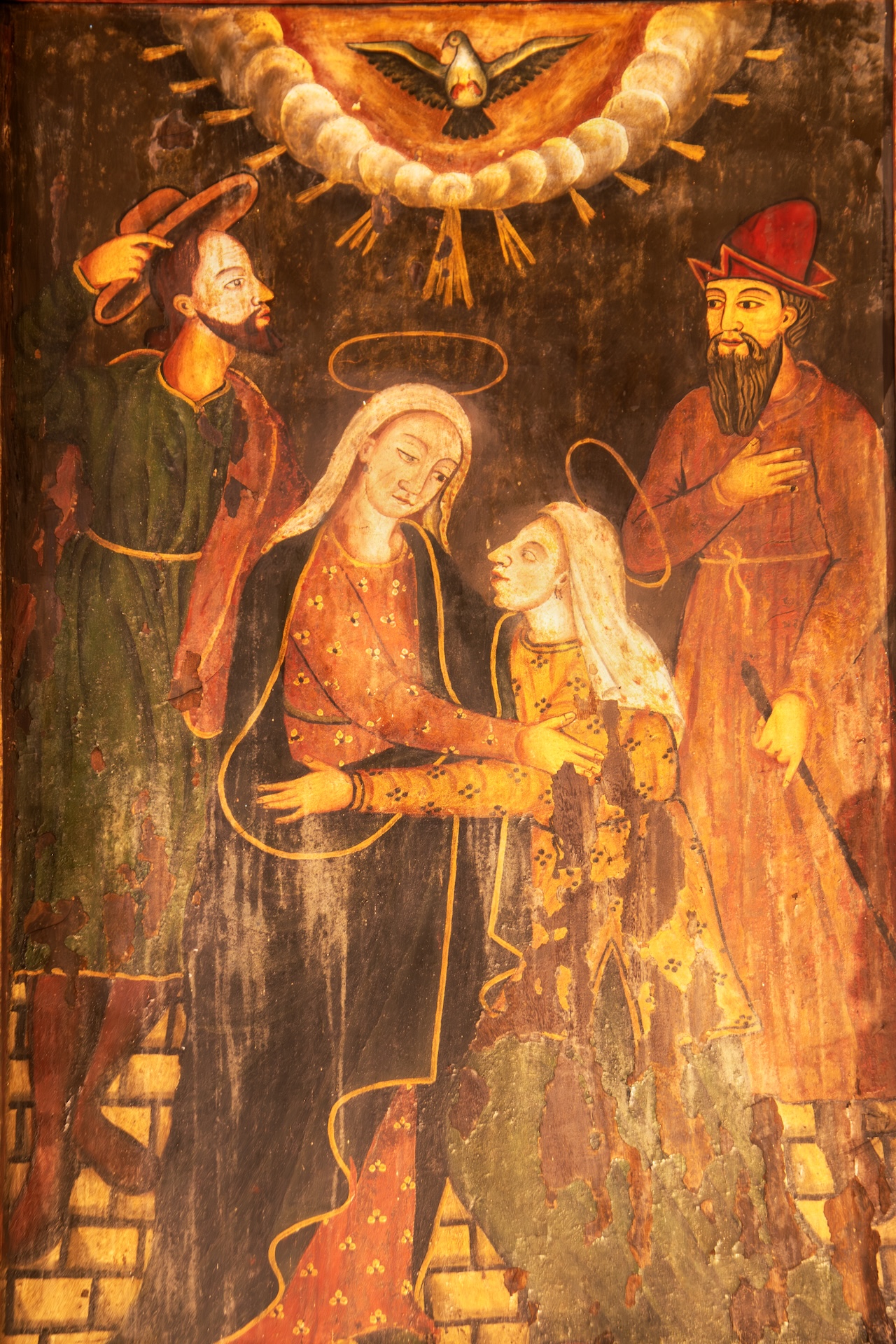
This photo-documentation engages with murals preserved in select Syrian Christian churches, particularly in central Kerala, and explores their role in shaping devotional consciousness. These sacred images—often located in the madbaha (sanctum sanctorum), along walls, and across ceilings—create an immersive spiritual environment. They transform architectural space into sacred presence, where visual narratives accompany liturgical performance and deepen contemplative experience.
The central inquiry of this work examines how visual representations influence the formation and experience of faith among Syrian Christians in Kerala. Through visual narratives of origin, migration, suffering, redemption, and divine intervention, murals articulate a collective spiritual history. They function simultaneously as aesthetic objects, theological statements, and cultural archives.
Beyond artistic value, these images historically served as powerful liturgical and pedagogical tools. In a context where literacy was limited and liturgical languages such as Syriac remained inaccessible to many believers, murals became visual scriptures. They narrated biblical stories, chronicled community history, and conveyed theological meanings through imagery. Episodes such as the Coronation of Mother Mary, the Last Supper, the Agony in Gethsemane, the Betrayal of Judas, the Trial, Crucifixion, and Resurrection became recurring motifs—forming a visual cycle of faith that believers encountered repeatedly in their devotional life.
These murals, often created using natural pigments and vegetable dyes, did more than illustrate sacred narratives. They generated a visual theology that extended beyond textual authority, offering new interpretative possibilities shaped by local culture and devotional practice. Through repetition, circulation, and contemplation, these images cultivated a shared spiritual imagination.
In their mediatory role, the murals transcend mere representation. They invite viewers into contemplative participation, dissolving boundaries between past and present, sacred and secular, visible and invisible. Through this encounter, visual experience becomes an act of devotion—an inward movement toward transcendence.
Over time, certain murals have acquired an additional layer of devotional significance. Some are believed to possess miraculous qualities or divine presence, attracting devotees seeking comfort, healing, or blessings. Reproductions and miniatures of these sacred images circulate widely—finding place in homes, workplaces, vehicles, wallets, and digital devices—extending sacred presence into everyday life. This circulation reflects how visual piety adapts to contemporary contexts while retaining its spiritual potency.
This documentation draws from murals and paintings found in selected Syrian Christian churches across Kerala, including sites in Kottayam, Piravom, Vadakara, Paliakkara, Kanjoor, and surrounding regions. Together, these visual traditions reveal a rich intersection of art, devotion, memory, and philosophy.
Ultimately, this work proposes that in the Syrian Christian tradition of Kerala, visuality is not merely aesthetic—it is experiential, theological, and transformative. The murals stand as silent yet powerful witnesses to a faith shaped by seeing, remembering, and believing.