
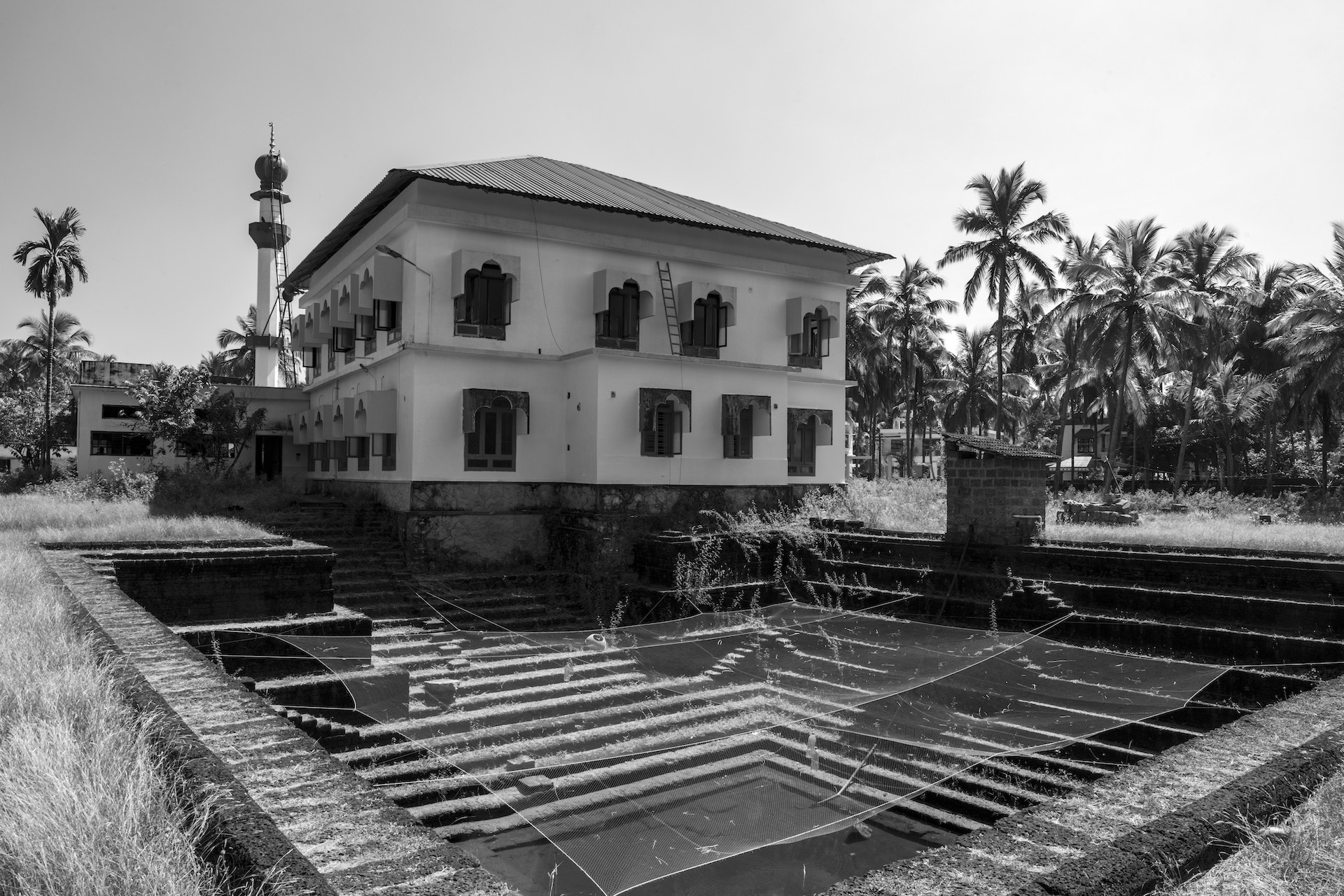
Visual narrative of Kerala’s mosque architecture through a spiritual lens.
Around the world, whenever mosques are built in a previously non- Islamic context, the functional and visual characteristics of mosque architecture have to deal with its new environment and context—one that has its own pre-existing historical, culture, traditions and visual vocabulary. Mosques built in such foreign context are characterized by two tendencies: Firstly, the design is influenced by the local context, modified by the Muslim immigrant’s community, the group who fund or by local regulations and laws; and secondly, the design makes references to regional traditions. In this context, there are many factors contributing to the shaping of the typology, design, and role of the mosque in a multicultural atmosphere. Among those factors are immigrants to these countries, laws of the country, the materials available for construction, the funding available, colonialism influence, culture, and tradition. This is evident in the functional and visual distinction between the architecture of the imperial & monumental mosques of north India to that of the traditional temple architecture of ancient mosques in the coastal state of Kerala.
The Arab traders shared a warm relationship with the coastal Kerala, even before the arrival of the Portuguese & the British, and it was mediated by the maritime trade facilitated by the Indian Ocean. They purchased black pepper which was an exclusive spice at that time, and other spices for which Kerala was well known, and exported them to European countries. Being global merchants, the Arabs had made their language popular across the globe and it was through their word of mouth that the news about Kerala being the land of spices had widely spread.
The friendly relationship of Arabs with the locals, landlords and the rulers and their regular visits during the Monsoon season were a reason why they Arabs could form their own settlements in the coastal cities of Kerala. Being, mostly a group of traders, the monopoly in maritime trade which the Arabs had enjoyed was one that was easily achieved without a single weapon, unlike the Portuguese and British who established dominance with the use of power. This characteristic was key to the Arab scholars and spiritual leaders paying visits to the coast the subsequent exchanges of culture and spirituality into the local life of Kerala. These holistic exchanges had grown wider with the abundant support from the local rulers.
The cultural and spiritual foundations of Kerala stood apart from that of the rest of the country due to two major reasons. Firstly, the mighty Western Ghats which stands tall between the neighbouring states and Kerala and thereby acting not only as a barrier for physical exchanges but also of knowledge and culture. Secondly, the isolated state being connected to the wide world of maritime traders and accompanying visitors including scholars, spiritual leaders, writers etc. Thus, foreign relationships had a significant role in the evolving cultural and spiritual life of Kerala. This difference is clearly evident in the way in which the religion, Islam, has arrived and enrooted here. In the North India, Islam had arrived as a result of Turkish and Persian invasion while in Kerala, this happened solely though the cultural exchanges with the Arab traders. Also, the favourable political environment prevailing in Kerala during that period had been a catalyst to the spread of Islam too. The absence of power politics in the Arab’s interactions with the locals, the close bonding with the rulers which the Arab had enjoyed, and the support they received from the rulers to construct buildings to perform their religious practices had led into the construction of numerous mosques across Kerala. Having said that, there are lot of factors that makes Islam in Kerala stand out in its apparent style from the rest of the country and one of the best examples to this difference can be explored in the traditional Mosque architecture of Kerala.
According to the historic records, Cheraman Perumal Juma Masjid situated in Kodungaloor, of Kerala is considered to be the very first mosque to be built in India and is reported to be constructed in 629 A.D. There are various historical accounts which says that Cheraman Perulam, who was the ruler of Tamilakam once had a mystical dream of moon being split into two. Years later, this dream was interpreted by a group of Arab travellers who paid visit to Perumal on their way to the Adam’s point at Srilanka, who told him that this dream must have connections with the Prophet Muhammad’s mystic abilities. Considering this as a call to Islam, Cheraman Perumal, on these traveller’s journey back, accompanied them and embraced Islam at Mecca, from the prophet himself.
After many years, Cherman Perumal decides to return to Kerala. However, on the way, he falls ill and passes away. Before that, Perumal entrusts the fellow travellers including Malik Ibn Deenar, to spread the religion in Kerala, and gives this in writing as letter of evidence for this. On their arrival to Kerala, having convinced by the letter, the local rulers gives permission and whole hearted support for the construction of mosques across Kerala. Following this, under the guidance of Malik Ibn Deenar, around ten mosques were built at different parts of the state. The group of Arab leaders who stayed back, were given land to build houses and this later developed into settlements around the mosques.
The earliest mosques in Kerala were built at Kodungalloor, Kollam, Berakkoor, Mangalore, Madayi, and Chaliyam. The first mosque among this was built at Kodungalloor in 629 A.D and following this another mosque was built at Quilon in 642 A.D. and at Kasaragod in 648 A.D.
It can be seen that the earliest mosques are being built according to the traditional Kerala architecture and doesn’t have minarets. This is very typical about Kerala’s ancient mosques which holds similarity to neither the simplicity of Arab architectural style nor to the grandeur of Indo Islamic style of north Indian mosques and is because these were being built by the native architects.
The mosques architecture in Kerala can be categorized broadly into traditional, Indo Islamic and Islamic styles and this also marks three different eras in time. The transition from traditional Kerala architecture to Indo Islamic and Islamic is evident in the later addition of Minarets and other details found in most of the mosques. Such Indo Islamic reconstructions can be observed in the Kannur Madayi Mosque and Cheraman Perumal Juma Masjid whereas the Palayam mosque in Thiruvananthapuram is an excellent example of Islamic architecture.
Since the arrival of Islam in 6th century AD, mosques have been instrumental in the formation and development of centres of trade and settlement in the surrounding area. The imprints of Kerala, Arabian, Turkish and Persian as well as Indo Islamic and Islamic architectural influence can be also studied through these constructions. Based on who designs or finances the project, the mosque architecture is influenced by a dominant style from one country or region. An example for this is the Kakkulangara Mosque built under the Kolathiri Kingdom with ties to Arakkal family, is one of the very rare mosques in Kerala having Turkish inspirations which could be attributed to the Arakkal family’s close knit bonds with the Turkish religious leaders. Most of the other early mosques have simple traditional temple architecture. The second important consideration in the ancient mosques of Kerala being transnational pertains to the environment & context especially the pre-existing history, culture, traditions and visual vocabulary of the locality. Third, the functional and visual characteristics of the mosque architecture attribute it a quality of monumentality. Monumentality in Architecture may be defined as a quality, a spiritual quality inherent in a structure which conveys the feeling of its eternity, that it cannot be added to or changed. The ancient mosques of Kerala has a uniquely humble visual vocabulary with regard to ‘monumentality’ in comparison with the grand monumental mosques of the Mughal and Qutb Shahi dynasty, for example. Fourth, the ancient mosques of Kerala, serve as the Holy resting places (Makhbara) to the religious and spiritual leaders of the bygone time, many of them from have routes to foreign countries. Their predecessors and their life is of interest in exploring mosques as a symbol of transnational heritage of the local communities. Unlike the ancient Mosques in Mughal era which speaks volumes about the imperial power, Kerala’s mosques built on the local temple architecture without much Islamic symbols, have not failed any lesser to survive the test of times. Many of them have been built by Hindu architects and artisans and even have engravings similar to temples. It is also of interest to document the influence of communal harmony on amalgamating the traditional practices and styles. A powerful example to this is the Aayiram Juma Masjid in Kasargod where the five yearly Uroos festival is being conducted with the support of the nearby Arashu Manjisnar Daivasthanam temple at Udyavar in Manjeswaram and the members of the mosques are invited to the annual festival at the temple every year by the ‘Velichappadu’ (Oracle) and the temple trust in a ceremonious style.
The ancient Mosques of Kerala and the surrounding local life has stories to tell about the cultural and spiritual exchanges of a bygone era. The proposed project aims to create a visual documentation of the Kerala’s traditional mosque architecture, archaeological inscriptions, engravings and also the life of people whose lives are closely tied to the mosque by heritage, work or otherwise. This will also include documenting Maqbaras or Holy tombs of spiritual saints who had influenced the cultural and spiritual history of the locality. The exploration is also into the history of the locality, transnational heritage of the local people and the remnants of the old settlements in the existing local life. In the shadows of these traditional mosques, in the narrow streets resides the tales of cultural and spiritual exchanges facilitated by the foreign trade across the Indian Ocean and these stories take us back to even the pre Islamic period about the myriad ways in which people welcomed each other’s ways of lives without mixing it with the imperial tool of power but through the unique human tendency to accept diverse ideas. The visual narrative of mosques and its local life through a spiritual lens would attempt to bring meaning to this rich history of diverse spiritual-cultural-religious co-existence in a multicultural context. Such efforts, in visual story telling would not only salve the consciousness but also rediscover its possibilities of mending the broken chains of harmony in history.